DIS-RUPT-URES | A Public Exhibition at Beit Beirut | Sep. 30, 2026
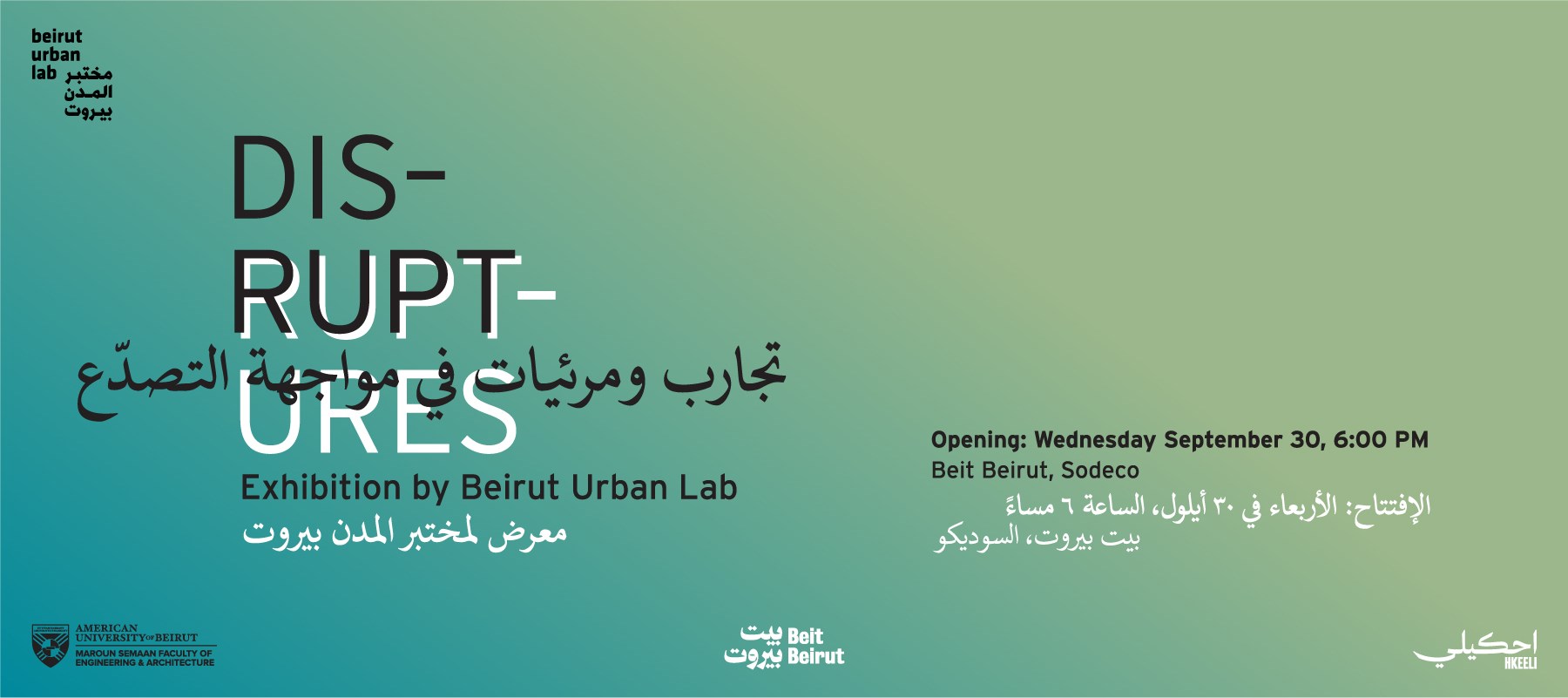
Join us for the opening of DIS-RUPT-URES: Exhibition by Beirut Urban Lab, set in Beit Beirut's Urban Observatory under the "Hkeeli" program.
Date: Wednesday, September 30, 2026, at 6:00 PM
Location: Beit Beirut, intersection of Damascus Road and Independence Avenue, Sodeco, Beirut
This event is open to the public.
×
×
Concept Note
This exhibition brings together a research-based, multi-format collection of works that respond to the interlocking ruptures that have marked Beirut, Lebanon, and the region over the past decade.
The exhibition showcases a selection of projects that seek to advance evidence-based narratives that expand the horizon of possibility and denounce the unfolding and cumulative effects of wars, forced displacement, settler colonial violence, the financialization of homes, the privatization of commons, and the erasure of people’s lives, traces, ecologies, and memories. Most of these works were produced between 2018 and 2026 by research teams at the Beirut Urban Lab, but the exhibition also includes a few earlier projects on which the Lab founders have collaborated since 2006.
In an age of post-truth and dominant right-wing populism where facts are confused with opinion, the projects’ denouncements—or disruptions—document, disentangle, and deconstruct conditions emerging from situations of crisis—or ruptures—and shape a data commons that stitches a shared infrastructure of knowledge through which reparative and retributive work can be co-produced. This includes reclaiming the social value of land, centering collective action and modalities of city-making, advancing equitable and collaborative governance, mobilizing shared heritage to strengthen inclusive forms of belonging, and crafting holistic visions of recovery. The resulting curated and visualized data therefore acts as the crucial canvas through which alternative narratives grounded in values of justice and radical ecological democracy can be experimented with and other urban futures imagined.
Key to the Lab’s methods of knowledge production is employing multiple visual approaches that are tailored to the needs of each issue and context. These approaches are based on the principles of critical cartography that simultaneously question traditional views of mapmaking and maintain responsible data visualizations that safeguard transparency, inclusivity, and the proclaimed positions of their authors.