Book Talk – The Social History of Amman through Photography
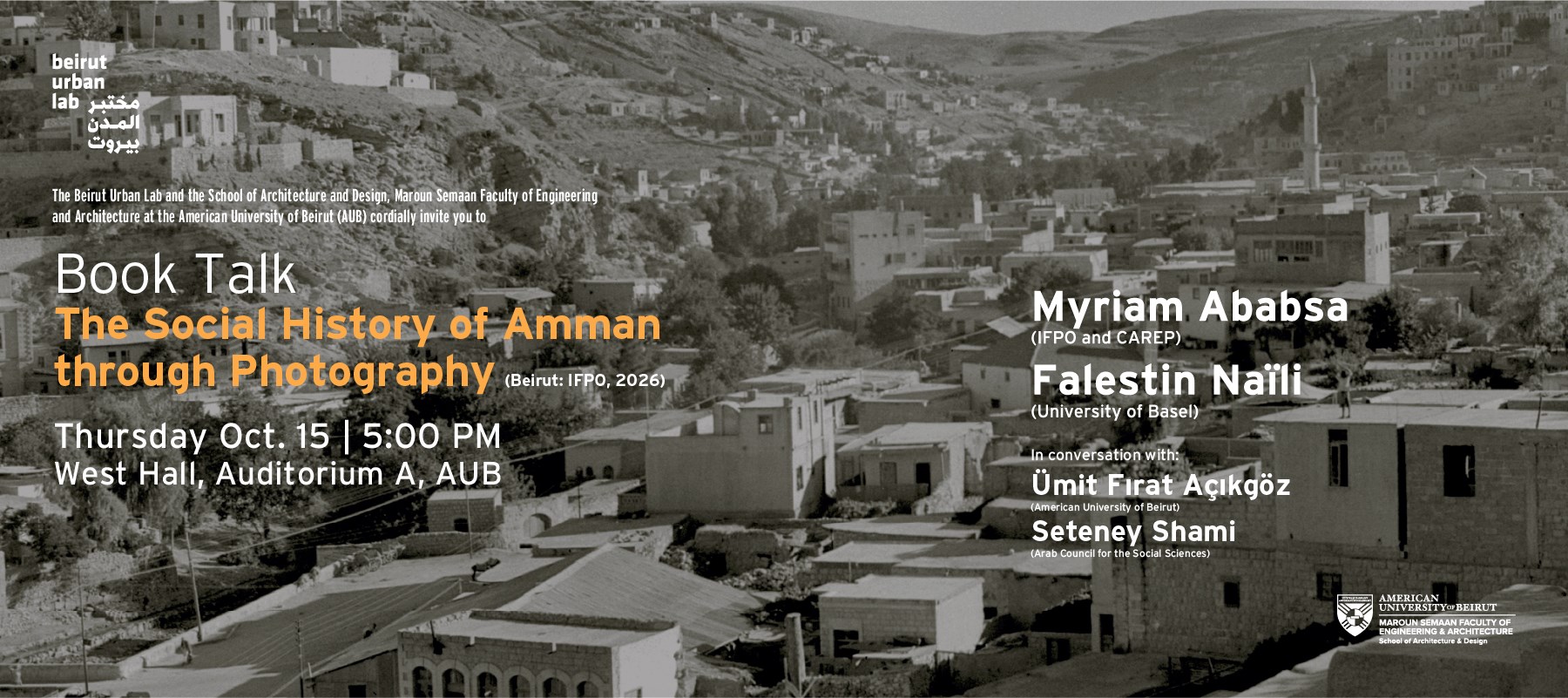
Join us for a book talk with Myriam Ababsa (IFPO and CAREP) and Falestin Naïli (University of Basel), in collaboration with the School of Architecture and Design.
The Social History of Amman through Photography (Beirut: IFPO, 2026)
Date: Thursday 15 October 2026 | 5:00pm
Location: West Hall, Auditorium A, American University of Beirut
In conversation with:
Ümit Fırat Açıkgöz (American University of Beirut)
Seteney Shami (Arab Council for the Social Sciences)
This event is open to the public.
About the book
The book discusses Amman’s urban form as the product of a complex interplay of power structures, political ambitions and social constructs. Rebuilt by Circassian migrants in 1878, the city became the capital of the Emirate of Transjordan after the First World War. During this period, the population grew significantly, with new arrivals, including internal migrants and those from neigh- bouring countries. After 1948 and 1967, the city experienced significant population shifts with the arrival of tens of thousands of Palestinian refugees, leading to new developments and the formation of diverse social groups. All of these groups have contributed to the city’s tangible and intangible heritage, although some of its elements have now disappeared. However, their photographic records remain, providing a valuable visual record of social structures and everyday practices in public spaces and social gatherings.
The use of photography as a means of documenting and preserving the history of ‘Ammān has undoubtedly been crucial over the past century. This volume covers the city from the first photograph taken in 1867 to the major turning point in the city’s history represented by the 1967 war. As historical artefacts, the photographs reflect the subjectivities of the pho- tographers and their representation of the city, with the inherent effects of making some social groups invisible. This book proposes to rediscover the history of Amman through the photographers’ perception of this urban territory ‘in the making’. It provides a comprehensive overview of the various representations of Amman, as well as a detailed exploration of the urban practices of different social groups over a period of one hundred years. It draws on a variety of sources, including images from public and private collections, to provide a thorough understanding of ʿAmmān’s social life, urban heritage and civic spirit. The aim is twofold: to reconstruct the history of the urban expansion of ʿAmmān and to illuminate the social, economic and political depths of its development.
ينتج الشكل الحضري لمدينة عمّان عن تفاعل معقّد بين هياكل السلطة والطموحات السياسية والبنية الاجتماعية. أعيد بناء المدينة على يد مهاجرين شركس في عام 1878، وأصبحت لاحقًا عاصمة إمارة شرق الأردن بعد الحرب العالمية الأولى. خلال هذه الفترة، ازداد عدد سكّانها بشكل ملحوظ مع وصول سكّان جدد منهم مهاجرون داخليون وآخرون من البلدان المجاورة. بعد عامَي 1948 و1967، شهدت المدينة تغيّرات ديموغرافية كبيرة مع وصول عشرات الآلاف من اللاجئين الفلسطينيين، ممّا أدّى إلى تطوّرات جديدة وتشكيل فئات اجتماعية متنوّعة. وقد ساهمت كلّ من هذه الفئات في تكوين التراث المادّي واللامادي للمدينة. على الرغم من اختفاء بعض عناصر هذا التراث، لا تزال السجلّات الفوتوغرافية موجودة، لتشكّل أرشيفًا بصريًّا قيّمًا للبنية الاجتماعية والممارسات اليومية في الأماكن العامة والمناسبات الاجتماعية.س
لا شكّ أنّ استخدام التصوير الفوتوغرافي كوسيلة لتوثيق وحفظ تاريخ عمّان كان أمرًا بالغ الأهمّية خلال القرن الماضي. يستكشف هذا الكتاب المدينة منذ أوّل صورة فوتوغرافية التُقطت في عام 1867 إلى نقطة التحوّل الرئيسية في تاريخ المدينة التي تمثّلت في حرب عام 1967. وباعتبارها وثائق تاريخية، تعكس الصور الفوتوغرافية وجهات نظر المصوّرين وتصوّراتهم عن المدينة، ما قد يؤدّي إلى تغييب بعض الفئات الاجتماعية.ش
يقترح هذا الكتاب إعادة اكتشاف تاريخ عمّان من خلال عدسة مصوّريها التي تلتقط مشهدًا حضريًّا « قيد التكوين »، ويقدّم نظرة شاملة لمختلف تمثيلات عمّان، موفّرًا دراسة تفصيلية للممارسات الحضرية لمختلف الفئات الاجتماعية على مدى مئة عام. وهو يعتمد على مصادر متنوّعة منها صور من مجموعات عامّة وخاصّة، ليقدّم فهمًا شاملًا للحياة الاجتماعية في عمّان وتراثها الحضري وروحها المدنية. والهدف من ذلك مزدوج: إعادة بناء تاريخ التوسّع الحضري لمدينة عمّان وإلقاء الضوء على الأبعاد الاجتماعية والاقتصادية والسياسية لتطوّرها.ش
Biographies
Myriam Ababsa is a social geographer who has worked for over 20 years as an urban specialist for the United Nations on housing, informal settlement upgrading, local governance, compact growth and land value capture instruments in the MENA region. A former student of the École Normale Supérieure (FSC 1993), she holds a PhD in Geography from the University of Tours (2004). She is an associate researcher at the French Institute for the Near East (IFPO), at CAREP Paris, and works for Lugarit. Her first book, Amman de pierre et de paix (Autrement, 2007), portrayed 27 figures from the worlds of art, architecture, and literature. Since then, she has edited Raqqa, territoires et pratiques sociales d’une ville syrienne (IFPO, 2009), Popular Housing and Urban Land Tenure in the Middle East (AUC, 2012), the Atlas of Jordan (IFPO, 2013), and, most recently, Syrian Society in War and Revolution (IFPO, 2025), co-edited with V. Napolitano. She has received a Special Mention for Best Doctoral Dissertation from the Syrian Studies Association in 2006, and the World Bank VPU Team Award for Innovation in 2019 and 2023.
Falestin Naïli is Assistant Professor in Near and Middle Eastern Studies at the University of Basel. She is a social historian specializing in late Ottoman and Mandate Palestine and Jordan. She has focused much of her recent research on local governance and politics, particularly in Jerusalem and its region. Through her interest in collective memory and oral history she often reaches present-time issues, including the politics of heritage. She was a core team member of the ERC project “Opening Jerusalem’s Archives” before joining the Institut français du Proche-Orient (Ifpo) Amman as a researcher and head of office between 2017 and 2020. She is the author of La Palestine entre Patrimoine et Providence (Karthala, 2022). In 2023, Falestin Naïli received a Consolidator Grant from the Swiss National Science Foundation for her current collective research project "Futures Interrupted: social pluralism and political projects beyond coloniality and the nation-state" (https://fi.hypotheses.org).
Seteney Shami is founding Director-General of the Arab Council for the Social Sciences (ACSS) since 2012. She is an anthropologist from Jordan and obtained her BA from the American University of Beirut and her MA and PhD from the University of California, Berkeley. She has conducted fieldwork in Jordan, Egypt, Turkey, and the North Caucasus. After teaching at Yarmouk University, Jordan, she moved in 1996 to the Population Council in Cairo. In 1999, she joined the SSRC in New York as director of the Middle East and North Africa program and the Eurasia program. She also developed the InterAsia Partnership program hosted by the SSRC until 2021 and currently hosted by the ACSS. Her publications include Seeing the World: How US Universities make knowledge in a Global Era (co-authored with M. Stevens and C. Miller-Idriss) Princeton University Press 2018; and “South and North, East and West: Knowledge Circulations and Connections in a Disordered World” In Thinking the Re-Thinking of the World (eds. K. Kresse and A. Sounaye), De Gruyter 2022.
Ümit Fırat Açıkgöz is an architectural and urban historian specializing in the modern Middle East and the Balkans, and the global urban history of the interwar period. His interests include urban planning, architecture, historic preservation, and representations of urban space, broadly defined, in visual and written media. Açıkgöz’s first book explores the urban modernization of Istanbul during the post-Ottoman/early republican period (1923-1949) at the intersection of local, national, and global dynamics. His second book project is a comparative urban history of the postimperial cities in Eurasia during the interwar period, which focuses on infrastructure, urban planning, contestations over the city, and the fictional representations of the urban. Açıkgöz is an Assistant Professor at the American University of Beirut, School of Architecture and Design. He received his PhD in Art History from Rice University.